Local Business Website Redesign Checklist
A local business website redesign should fix the buying path first: clear services, mobile calls to action, booking, trust signals, ownership, and the right sco
Start with the job your site has to do
Write down the main action you want from the site. Most local businesses want one of these:
- Calls
- Appointment bookings
- Quote requests
- Menu views
- Service-area checks
- Directions to the location
Pick one primary action. Then review every page against it.
A salon may want online bookings. A contractor may want quote requests. A cafe may want menu views and directions. Your homepage should push that action without making visitors read your company history first.
If your site has no clear primary action, redesign the structure before you touch colors or fonts.
Check the five pages most local businesses need
A simple local business site can work with five strong pages:
| Page | What it must answer |
|---|---|
| Home | What do you do, who do you serve, and what should visitors do next? |
| Services | What can someone buy or book? |
| About | Who runs the business, and why should visitors trust you? |
| Testimonials or proof | What can visitors verify before they contact you? |
| Contact | How can someone call, book, visit, or request a quote? |
Patchwork Sites' Launch package covers up to five pages for $997. That scope fits businesses that need a professional site and do not need to edit content inside a CMS.
If you need service pages for several categories, location pages, a blog, or staff-editable announcements, five pages may feel tight. That usually points to Grow or Custom.
Audit the mobile version first
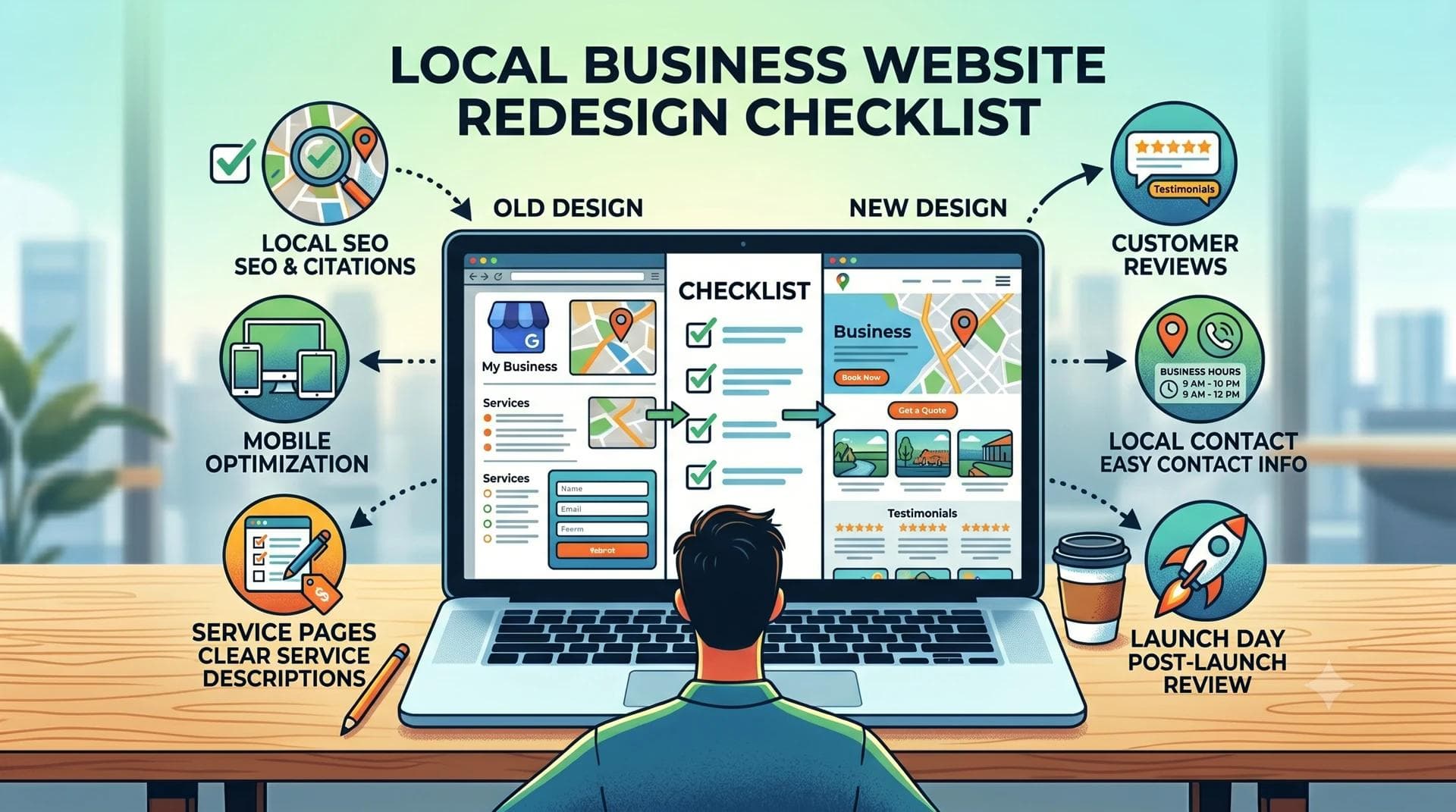
Most local customers see your site on a phone. Open your site on mobile and check these items:
- The phone number is easy to tap.
- The booking button appears near the top.
- The menu does not hide key pages.
- Text does not run edge to edge.
- Images load without pushing the page around.
- Forms work without pinching or zooming.
Do not judge your site from a desktop monitor only. A page can look fine on a laptop and still lose mobile visitors because the call button sits at the bottom or the form breaks on small screens.
Fix trust gaps before adding more pages
Visitors look for signs that your business is real. Give them those signs near the top of the page.
Add or improve:
- Real business name and service area
- Phone number or booking path
- Hours, if customers need them
- Location details, if you serve walk-in traffic
- Reviews or testimonials you can verify
- Clear service descriptions
- Photos from the client when available
Use stock imagery when you need a clean visual baseline. Use custom photos when you have them. Do not fake customer proof, traffic numbers, or rankings. A plain, accurate site beats a loud site with claims you cannot back up.
Decide whether you need a CMS
A CMS helps when your team needs to update content without a developer.
Choose a CMS if you plan to edit:
- Services
- Hours
- Team profiles
- Blog posts
- News items
- Menus
- Galleries
- Location details
Patchwork Sites' Grow package is $1,797 and includes up to seven pages plus Sanity CMS. It fits businesses that want a real site and the ability to manage updates after launch.
Skip the CMS if your content stays stable and you would rather ask Patchwork to make occasional edits. That keeps the build simpler.
Review booking and form needs
Booking embeds come with every Patchwork Sites tier. If you use Calendly, Square, Toast, Jane, GlossGenius, or another booking tool, your redesign should place that path where customers expect it.
Custom forms and API integrations need a custom quote. That includes flows like:
- Multi-step quote forms
- CRM submissions
- Custom intake routing
- Member or client portals
- Inventory or scheduling API work
Do not hide these needs until the end. They change the scope.
Check speed, security, and maintenance pain
Many older local business sites run on WordPress with old plugins, heavy themes, and unclear ownership. That setup can work, but it often creates maintenance work the owner never asked for.
Ask these questions:
- Who owns the hosting account?
- Who owns the domain?
- Who can access the code or builder?
- Which plugins are required?
- Who handles updates?
- Does the site load fast on mobile?
Patchwork Sites builds on a modern stack with Vercel deployment, Sanity for CMS-backed sites, and GitHub repo handoff. That gives the business a cleaner ownership path than a locked builder or mystery plugin stack.
Map the redesign to the right Patchwork tier
Use this table before you ask for a quote.
| If you need | Start here |
|---|---|
| Up to five pages, no CMS, booking embed, stock imagery, Vercel deployment, one revision round, GitHub repo handoff | Launch at $997 |
| Up to seven pages, Sanity CMS, blog or news available, booking embed, stock imagery, GitHub repo handoff | Grow at $1,797 |
| Eight or more pages, multiple CMS content types, custom forms, API integrations, or unusual structure | Custom quote |
Hosting for Grow and Custom builds can run $49 to $99 per month. SEO add-ons run $297 to $397. Forms and API work need a custom quote.
Build the redesign brief
Before you book a call or request a quote, gather the basics:
- Current website URL
- Pages you want to keep
- Pages you want to remove
- Services or offers you want featured
- Booking tool or contact method
- Logo files
- Brand colors, if you have them
- Custom photos, if you have them
- Copy for each page
- Examples of sites you like
Clients provide copy and custom photos. Patchwork Sites includes stock imagery, but your own photos make the site feel more local and specific.
Keep the scope honest
A redesign gets expensive when small requests turn into a hidden product build. Keep the first version focused.
For many local businesses, the best first step is Launch: five pages, clear calls to action, mobile-ready design, booking embedded, and no CMS to manage. If you need to update content often, start with Grow. If your site needs custom forms or deeper integrations, ask for a Custom quote before anyone starts design.
Pick the tier that matches the work. Then launch the site and improve from there.
Frequently asked questions
How do I know if my local business website needs a redesign?
Your site needs a redesign if visitors cannot tell what you do, where you work, or how to contact you within a few seconds. Broken mobile layouts, slow pages, unclear service pages, and outdated contact details are also strong signs.
Is a five-page website enough for a local business?
A five-page site is enough for many local businesses when the offer is simple. Home, Services, About, Testimonials, and Contact can cover the core buying path. Businesses with many services, locations, or editable content may need Grow or Custom.
Does Patchwork Sites include booking embeds?
Yes. All Patchwork Sites tiers include booking embeds. Custom forms and API integrations are separate and need a custom quote.
Do I need to provide copy and photos?
Yes. Clients provide copy and custom photos. Patchwork Sites includes stock imagery when you need it, but real business photos make the site stronger.